


Beauty in Decay: 10 AI Prompts for Hauntingly Gorgeous Abandoned House Art
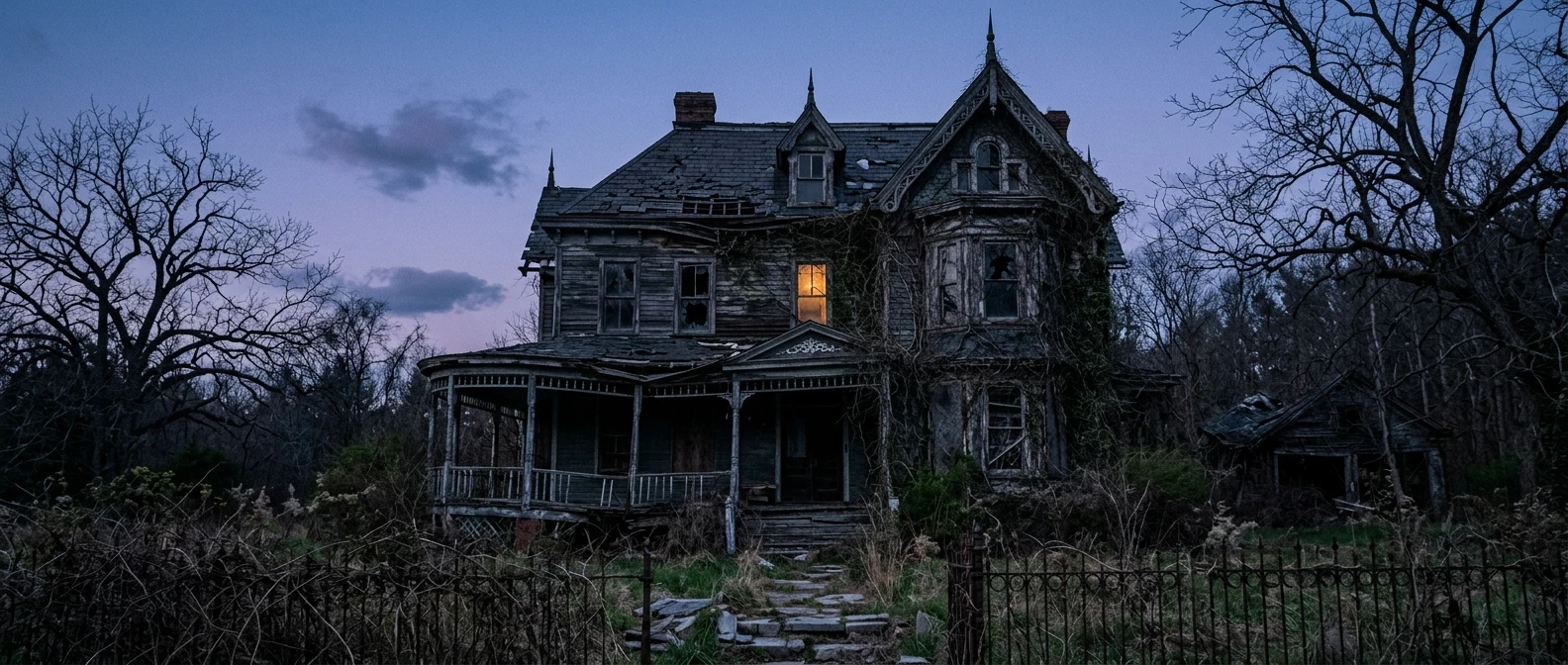
Decay has a strange advantage over almost every other subject you can ask an AI model to render: it photographs well even when it’s imperfect, because imperfection is the point. A crack in a wall, a sagging ceiling, a patch of rust bleeding down a doorframe, these aren’t flaws in the image, they’re the subject. Most other scenes need to look clean to look convincing. Abandoned houses need to look wrong in exactly the right places.
That’s also why so many abandoned-house prompts fall flat. Someone types “old abandoned house, spooky, detailed” and gets a generic haunted-house render that could be a video game loading screen. It has decay, technically, but no atmosphere. No sense of time passing, no light telling you a story, no texture you can feel through the screen. The difference between that and an image that actually makes someone stop scrolling comes down to a handful of specific choices, and this article hands you ten prompts built around those choices so you can paste them into kre8or.ai and see the difference immediately.
If you haven’t yet read the general guide to writing AI art prompts that actually work, it’s worth a look before or after this one. This piece builds on that foundation but focuses entirely on one subject: the abandoned home, and the specific language that makes it feel real.
Why decay photographs so well in AI art (and why most prompts miss it)
Decay works visually because it’s full of contrast. Smooth drywall against crumbled plaster. A pristine shaft of light against a blackened corner. A single intact window against three that are shattered. AI models are good at rendering contrast when you give them something to contrast, and bad at rendering decay when you just tell them “make it decayed.”
The mistake most people make is treating decay as a single adjective instead of a set of materials. “Abandoned” tells the model almost nothing about what to paint. “Peeling floral wallpaper curling away from water-stained drywall” tells it exactly what to paint. The gap between those two instructions is the gap between a flat render and something that looks like a photograph someone risked a tetanus shot to take.
The 3 ingredients every abandoned-home prompt needs: light, texture, and story
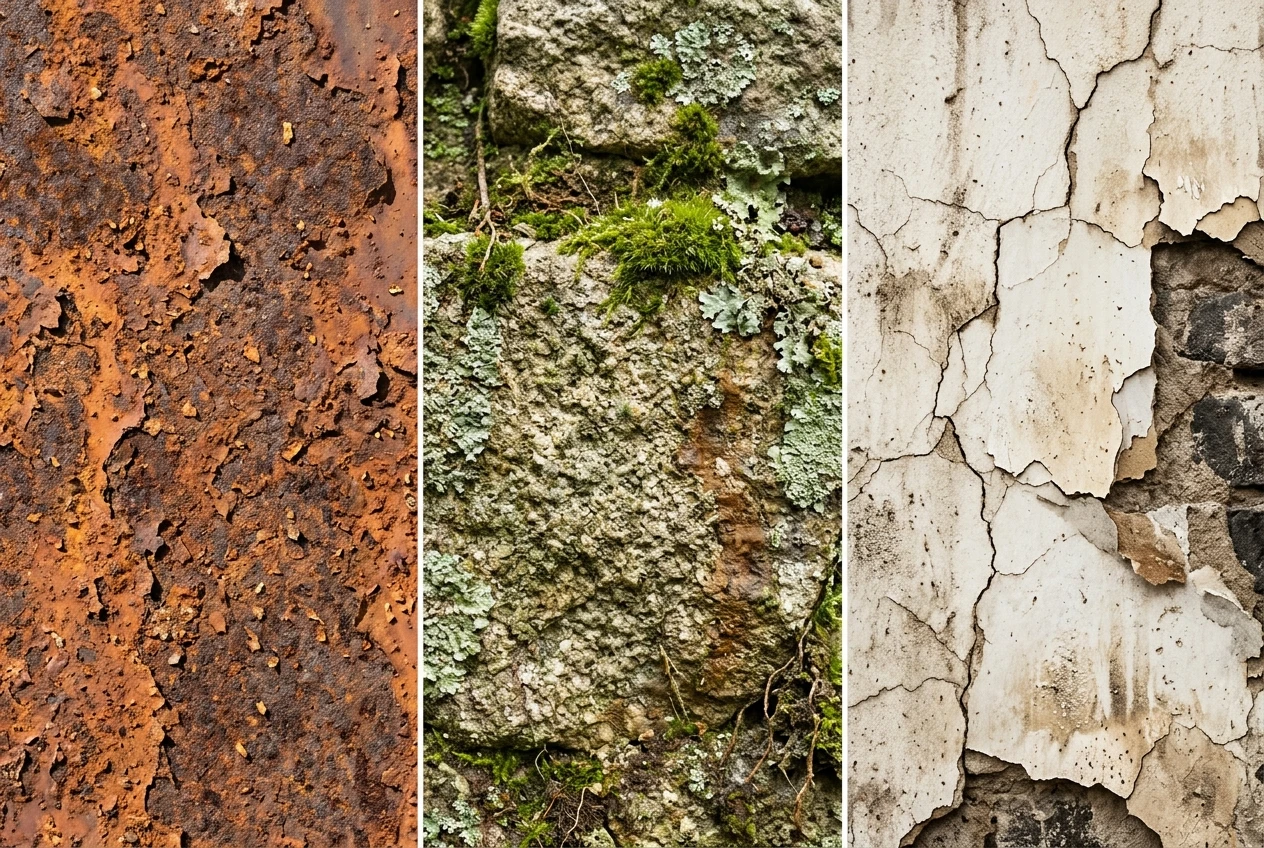
Before you get to the ten prompts, it helps to understand the formula underneath them, because once you see it, you can build your own variations endlessly.
- Light does the emotional work. Harsh midday sun reads as abandonment without sadness. Soft golden hour light through a broken window reads as grief, or memory. Blue, cold light reads as isolation. Decide what you want the viewer to feel, then choose the light that produces that feeling, not just light that looks nice.
- Texture is what sells the realism. Rust, moss, rot, dust, peeling paint, warped wood, cracked plaster. Name the specific material and what’s happening to it. “Decaying wood” is vague. “Wood paneling swollen and splitting from years of moisture” is specific enough for the model to render convincingly.
- Story is the detail that makes a viewer stop and wonder what happened here. A child’s shoe left on a staircase. A piano with its lid still open. A calendar on the wall stopped on a date. You don’t need an elaborate backstory, just one object that suggests people once lived here and left in a hurry, or didn’t leave at all by choice.
Every prompt below weaves these three ingredients together. Notice the pattern as you read them, because that pattern is what you’ll reuse once you start writing your own.
Prompt 1 and 2: Sunlit decay, overgrown interiors reclaimed by nature
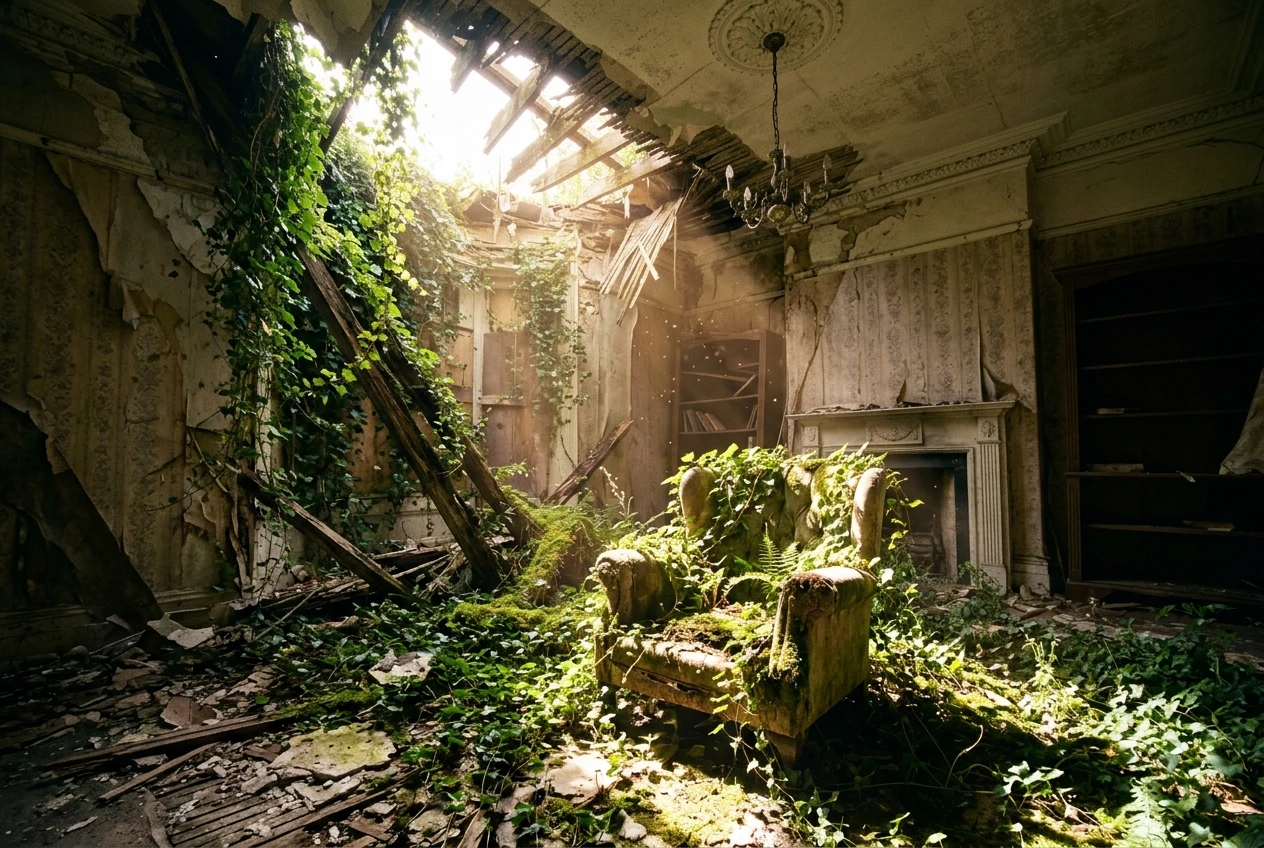
Prompt 1: “Interior of an abandoned Victorian living room, sunlight streaming through a collapsed ceiling, vines and ivy growing up through the floorboards and across a moss-covered armchair, dust particles visible in the light beams, warm golden tones, photorealistic, shallow depth of field, shot on 35mm film.”
Prompt 2: “Abandoned greenhouse conservatory reclaimed by ferns and climbing roses, broken glass panels letting in dappled sunlight, cracked stone floor tiles overgrown with moss, a rusted wrought-iron table still set with a tea cup, soft natural lighting, cinematic composition, hyperrealistic detail.”
Nature reclaiming a space is one of the most satisfying decay themes because it tells a clear, hopeful story even inside a sad scene: life goes on, even here. Keep the plant growth specific (ivy, moss, ferns) rather than generic (“plants”), and always pair it with one untouched human object, like that teacup, to keep the emotional contrast sharp.
Prompt 3 and 4: Misty exteriors and fog-choked porches at dawn
Prompt 3: “Exterior of an abandoned farmhouse at dawn, thick fog rolling across an overgrown front yard, porch sagging and missing several floorboards, a rocking chair tilted on its side, muted blue-grey color palette, soft diffused light, atmospheric haze, cinematic wide shot.”
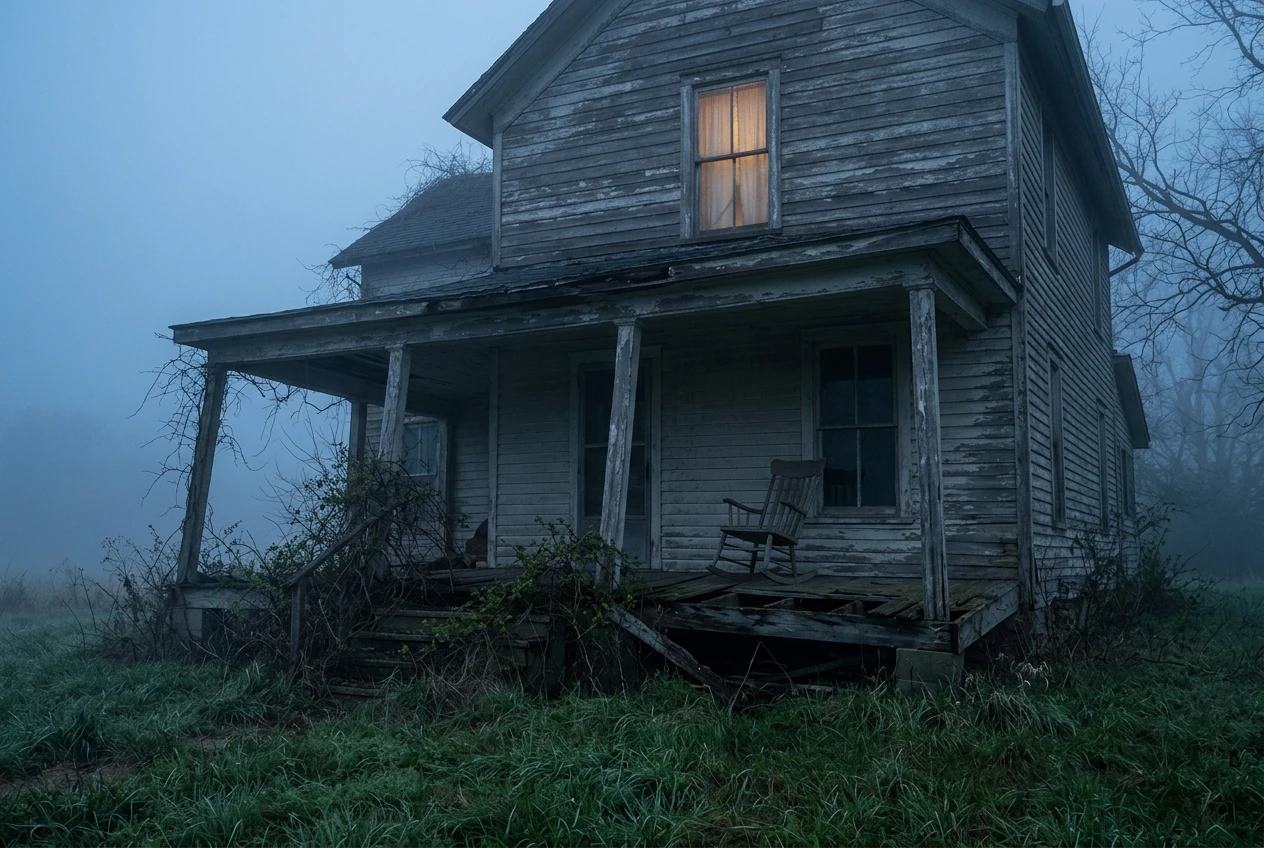
Prompt 4: “Abandoned two-story colonial house seen through fog-shrouded trees, broken shutters hanging loose, peeling white paint revealing grey wood underneath, a single upstairs window faintly lit from within, early morning mist, desaturated color grade, moody and quiet composition.”
Fog does a lot of heavy lifting in these prompts. It softens edges, hides detail the model might otherwise render poorly, and adds an instant sense of isolation. Notice the “single lit window” detail in Prompt 4. That’s a story element doing double duty as a focal point, drawing the eye and raising a question the viewer can’t answer.
Prompt 5 and 6: Peeling wallpaper close-ups and forgotten furniture portraits
Prompt 5: “Extreme close-up of peeling floral wallpaper in an abandoned bedroom, water stains bleeding through faded pink roses pattern, exposed plaster and lath showing beneath torn edges, soft window light raking across the textured surface, macro photography style, fine detail, warm nostalgic tone.”

Prompt 6: “Portrait of a dust-covered upright piano in an abandoned parlor, keys yellowed and some missing, sheet music still open on the stand, soft directional light from a nearby window, shallow depth of field blurring the room behind it, melancholic and intimate framing.”
These two work because they zoom in rather than out. Wide shots establish atmosphere, but close-ups create intimacy. A single object rendered in careful detail, like that piano with the sheet music still open, often carries more emotional weight than an entire ruined house shown from a distance. Use these when you want a piece that feels personal rather than sprawling.
Prompt 7 and 8: Golden hour through broken windows and dust-lit staircases
Prompt 7: “Abandoned dining room at golden hour, warm amber light pouring through a shattered bay window, dust motes suspended in the light beam, a long wooden table covered in a thick layer of dust and fallen leaves, chairs overturned, cinematic lighting, high dynamic range, film photography aesthetic.”
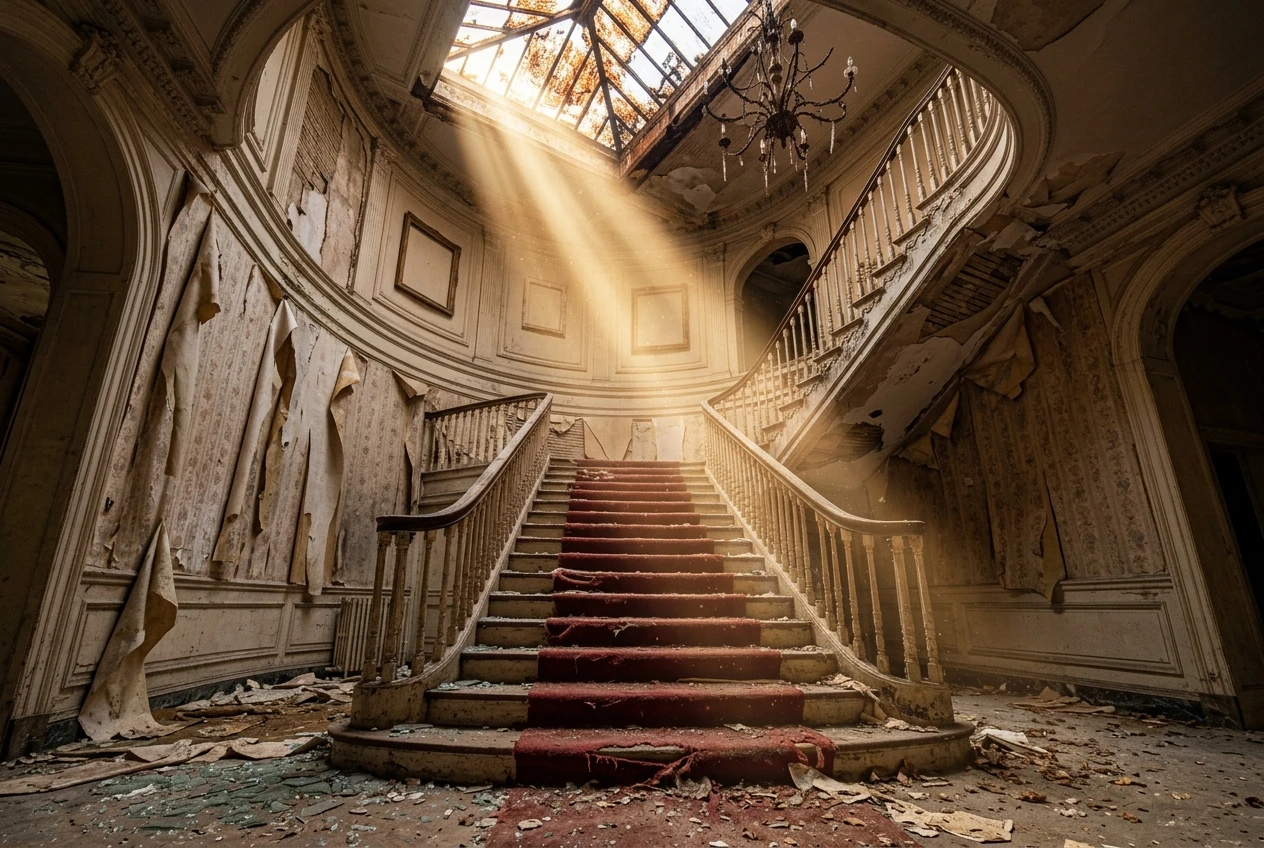
Prompt 8: “Grand staircase inside an abandoned mansion, afternoon light cutting diagonally through a broken skylight above, dust floating visibly in the light shaft, peeling wallpaper along the staircase walls, a worn red carpet runner faded and torn, dramatic chiaroscuro lighting, wide-angle composition.”
Golden hour and dust are a natural pairing: the warm light makes every suspended particle visible, and that visible dust is often what separates a believable abandoned interior from a sterile 3D render. Always specify the time of day and the direction the light travels, since that single detail controls where every shadow falls in the final image.
Prompt 9 and 10: Winter ruins and flooded, moss-covered rooms
Prompt 9: “Abandoned log cabin in a snow-covered forest, roof partially collapsed under heavy snow load, icicles hanging from the eaves, a single broken window frame with snow drifting inside onto a dust and frost covered floor, cold blue winter light, overcast sky, stark and desolate atmosphere.”
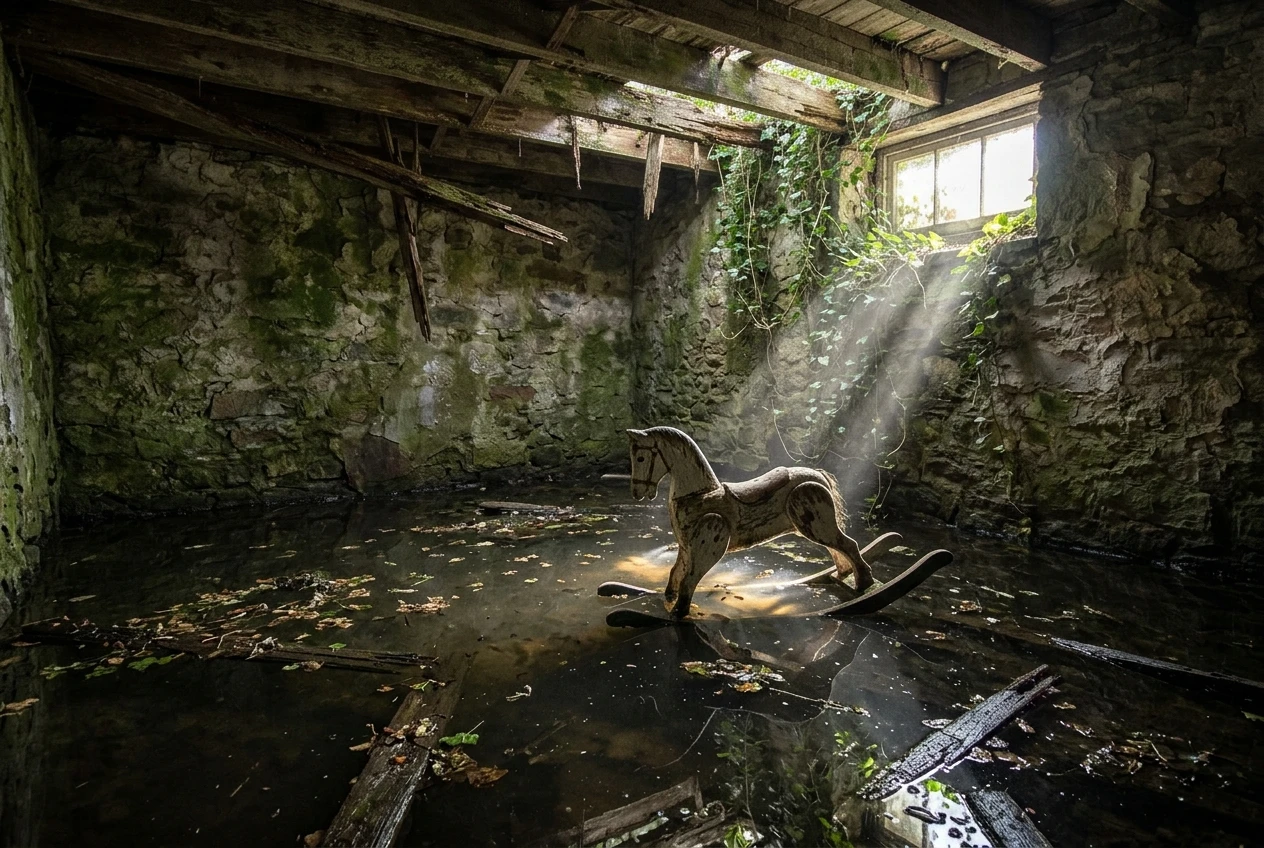
Prompt 10: “Flooded basement room of an abandoned house, standing water reflecting broken ceiling beams above, thick moss and algae growing up the stone walls, a child’s rocking horse half-submerged near the edge of the water, single shaft of light from a ground-level window, eerie and still, high detail reflection rendering.”
Winter and flood scenes both rely on one extra technical element most people forget: reflection and refraction. Snow reflects available light and brightens shadow areas in a way dry decay doesn’t, while standing water acts almost like a mirror, doubling every detail above it. Mention the reflection directly in your prompt, as Prompt 10 does, so the model knows to render it rather than leaving the water flat and opaque.
Tweaking these prompts in kre8or.ai to match your own abandoned-house vision
These ten prompts are starting points, not fixed scripts, and the fastest way to make them your own is to change one ingredient at a time rather than rewriting the whole thing.
- Swap the time of day: Try the staircase prompt at dusk instead of afternoon and watch the mood shift from dramatic to somber.
- Swap the material: Replace “floral wallpaper” with “striped wallpaper” or “wood paneling” and the entire texture language of the scene changes.
- Swap the story object: A teacup, a rocking horse, a piano, a pair of shoes: each one implies a different kind of life that used to exist in the room.
- Adjust the color grade: Add “desaturated,” “sepia-toned,” or “high contrast black and white” at the end of any prompt to shift the emotional register without touching the composition.
Run the same prompt twice with only one of these variables changed, and you’ll start to see exactly which words are doing which job in the final image. That’s the fastest way to build real prompt intuition rather than just collecting prompts you don’t fully understand.
Where to go next if you want sharper prompt control
Once you’re comfortable with the light, texture, and story formula for abandoned homes, the same structure carries over to almost any atmospheric subject you want to render, from foggy forests to neon-lit city streets. If you want to see how this same precision applies to a completely different style, the breakdown of cyberpunk portrait prompt syntax walks through the same principle applied to a sharper, more technical subject.
Open kre8or.ai and paste in your first decay prompt to see these 10 scenes come to life.